Fully Continuous Pyrolysis Equipment
Blackgold P30 Official Launch Event
New Product Launch | Industry Insights | Live Plant Visit
 Date: October 15, 2026
 Location: Zhengzhou City, China
Register Now!

Coming October 2026
Blackgold P30 Launch Event
On October 22, 2026, Beston Group will unveil a global breakthrough in continuous pyrolysis — “Blackgold P30” — in Jiaozuo, Henan, China. We cordially invite you as our honored guest to witness the new era in continuous pyrolysis technology.
Become a Participant
Which Raw Materials Can Be Converted Into Value?
Waste Plastics
Final Products :Pyrolysis oil, Syngas, solid residue
Waste Tires
Final Products: Pyrolysis oil, rCB(carbon black), Syngas, steel wire
Oil Sludge
Final Products: Pyrolysis oil, Syngas, metal recovery,sand, water
End Product Commercial Value:
Light Oil
Chemical Feedstock: Produces propylene, butadiene, and ethylene for manufacturing plastics, rubbers, and other synthetic materials.
Fuel Production: Can be catalytically reformed into gasoline or processed into kerosene, jet fuel, and various fuel oils.
Solvent Applications: Serves as an effective solvent in industrial and laboratory settings for adhesives, coatings, inks, and extraction processes..
Non-Standard Diesel
Industrial Fuel: Suits for boilers, furnaces and more to replace traditional fuel oil.
Power Generation: Used as fuel for diesel generators.
Marine and Construction Machinery Fuel: Direct use in ships, construction, or agricultural machinery
where emission standards are less strict.
Pyrolysis Oil
Used as fuel
Directly sold to steel mills, boiler plants, cement plant.
Turned into high-quality fuel oil after purification, mixing with standard diesel for low-speed heavy
machinery, construction machinery, large trucks, and ships.
Combustible Gas
Used as fuel in combustion chambers
Collected separately for other uses
rCB(recovered Carbon Black)
The rCB, a kind of eco-friendly material, is a key ingredient in the manufacture of eco-friendly tires.
The rCB can be directly used in the production of cement, asphalt, inks, coatings, and other industrial
materials.
Discover the New Generation Blackgold P30!
Industry Status
- Condensation blockage & unstable operation
- High energy consumption & emission risks
- High labor and operating costs
- Unstable oil quality & market value

Blackgold P30
- Fully Continuous operation for 30 days without stopping
- Self-Regulating Sealing Technology for improved safety and operational reliability
- High Automation, Low Labor Demand with only 2-3 operators per shift
- Temperature control accuracy ±5-10℃ for Stable Operation and higher oil quality
- Waste Gas Recovery System converts pyrolysis gas into Light Oil, maximizing energy utilization
 Tire Rubber Granules
 Plastic Pellets
 High Quality Fuel Oil
Why Does the Industry Need the New-Generation P30?
400Million TonsPlastic Waste
Generated Globally
Every Year
1.5-2BillionEnd-Of-Life Tires
Discarded Annually
Pyrolysis has become the inevitable path to waste-to-resource conversion. However, the industry still
faces four core critical challenges:

01
Wax Oil Clogging
Wax oil buildup leads to plugging and unstable operation.

02
Frequent Downtime
Unplanned shutdowns reduce productivity and increase costs.

03
Coking
Carbon deposits affect efficiency, yield, and equipment lifespan.

04
Environmental Compliance
Stricter emission rules require better environmental performance
Free Download P30 Pyrolysis Plant ROI Analysis
Thank you for your interest. Download the ROI analysis now to check quantified costs, benefits, payback period, return rate, and output revenue.
Waste Plastic Pyrolysis ROI Report
Download
Waste Tyre Pyrolysis ROI Report
Download
Oil Sludge Pyrolysis ROI Report
Download
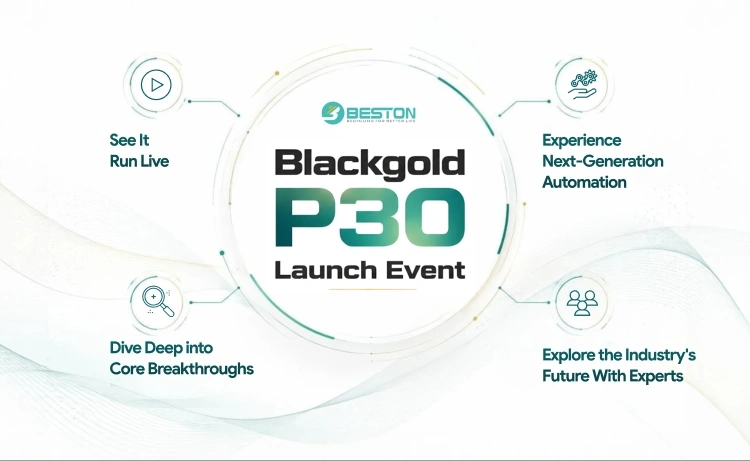
What Awaits You at the Launch Event?
 See It Run Live
Experience the full P30 process on site, from continuous feeding and pyrolysis
to oil output, with real-time yield and quality data.
 Experience Next-Generation Automation
See how intelligent controls reduce labor and energy use while
ensuring compliance.
 Dive Deep into Core Breakthroughs
Learn how P30 prevents wax blockage and coking, improves oil
quality, and enables safe 24/7 operation.
 Explore the Industry’s Future With Experts
Discuss the latest pyrolysis trends, market opportunities, and
future outlook with industry experts.
Event Agenda
 TIME TIME |
 ITEM ITEM |
 SPEAKER SPEAKER |
| AGENDA OF DAY ONE (15 OCTOBER 2026) |
| 08:20–09:20 |
Registration |
|
| 09:20–09:25 |
Welcome Address |
Henry He, CEO of Beston |
| 09:25–10:10 |
Blackgold P30 Introduction |
Henry He, CEO of Beston |
| The Solution of Collecting Excess Pyrolysis Gas to Convert Gasoline Blending Components |
| 10:10–10:40 |
Q&A |
Engineer Feng, Product Manager |
| 10:40–11:10 |
Coffee Break |
|
| 11:10–12:00 |
Industry Experts Sharing & Customer Case Sharing and Interaction |
|
| 11:20–13:30 |
Networking Lunch |
|
| 13:00–15:10 |
Move to Beston Factory |
|
| 15:20–16:20 |
Factory Visit |
|
| 16:20–18:00 |
Blackgold P30 Introduction Demonstration & Live Equipment Showcase |
Mark Zhang, Project Consultant |
| Excess Pyrolysis Gas to Convert Gasoline Blending Components Introduction Demonstration & Live Equipment Showcase |
| 18:00–18:30 |
Signing Ceremony for New Product Launch |
Henry He, CEO of Beston |
| 18:30–18:40 |
Closing Speech and Wrap-up |
Henry He, CEO of Beston |
| 20:10–22:00 |
Thank-You Dinner |
All |
| AGENDA OF DAY TWO (16 OCTOBER 2026) |
08:30–14:00
Option1
|
Shaolin Temple Half-day Tour Visit the birthplace of Shaolin Kungfu, enjoy Kung Fu performance,
and experience Zen Buddhist cultural heritage. (Voluntary participation) |
 |
09:00–18:00
Option2
|
One-on-one Exclusive Technical & Business Communication |
|
Moments from Previous Exchange Conference
Series of Beston pyrolysis technical exchange events have consistently appealed to global industry leaders across the solid waste recycling sector. We gathered to discuss the latest technical innovations and foster deep collaboration.
“That was a very valuable experience. We learned a lot about the equipment, the processes, and the
startup.”
Rimvydas MatijošaitisCEO · Energy Industry · Europe
“Seeing the equipment running in person gave us a completely different perspective. We left with a much
clearer plan for the next phase. Thank you for your explanation, thank you for your hospitality.”
Mortaza AghbashloProfessor · Energy Resources Sector · Middle East
100+ Industry Top Strategic Partners
Our company has established deep strategic partnerships with leading global companies, which not only enhances our technical strength, but also proves the global recognition of P30

Corsair of the Netherlands:
Corsair has strong technical accumulation and market influence in the field of waste resource utilization. As its strategic partner, we work with it to promote the application of innovative technologies.

Silver Star, the second largest oil company in Nigeria:
Silver Star is the second largest oil company in Nigeria and a leader in the oil industry. The strategic cooperation with it has enabled our technology to be widely verified and recognized by the market.
Secure Your Participation
We sincerely invite you once again to join Blackgold P30 New Product Launch. The Blackgold P30 represents more than just a technological breakthrough in tire and plastic waste recycling — it is a commitment to a cleaner, more efficient, and sustainable future. Together, let’s unlock the hidden value in waste and lead the industry into new era of continuous pyrolysis.


 Strategic partner of Exomad, the world’s largest carbon sink supplier.
 Technology partners of Puro.earth & Isometric
 100+ Countries Installation Sites




 Tar-free carbonization process for cleaner operation and higher system reliability.
 Biochar verified by accredited German laboratories, meeting most EBC application requirements and aligning with Puro.earth standards.
 Fully automated control system delivering enhanced safety, stable performance, and user-friendly operation.


